

Category: Town Planning
Not very long ago, common wells were an integral part of everyday life in Rajapalayam. Almost every two or three streets had a public well, while the longer streets often had one of their own. These wells were the lifeline of the community, providing water for drinking, bathing, washing clothes, household chores and even irrigation. They were not merely sources of water but also places where neighbours met, conversations flourished and community bonds were strengthened.
The arrival of borewells and piped water connections to individual households gradually transformed this way of life. As water became available at the doorstep, the dependence on common wells declined sharply. Over the years, many wells disappeared altogether, filled up and replaced by houses or other structures.
Several of the remaining wells have been covered with concrete slabs, with only a pipe extending into the well to draw water. Others have been neglected for decades, their water left stagnant and polluted as they fell out of use. Sadly, some have even become dumping grounds for household solid waste.
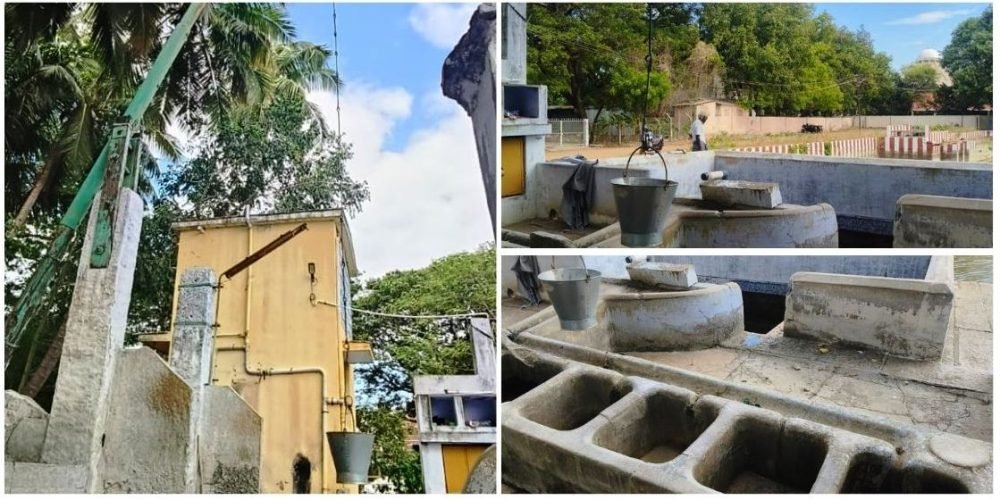
Amid this changing landscape, a handful of wells continue to serve the public, thanks to the dedicated efforts of local communities. One such well is located behind Arulmigu Sokkar Kovil in Rajapalayam. Believed to be around 100 years old, it remains in regular use, with people visiting every day to take a bath.
What makes this well particularly distinctive is its traditional ‘thula’, a counterpoise water-lifting mechanism that has been used in India for centuries. The device consists of a long wooden pole pivoted on a vertical support, with a bucket attached to one end and a heavy stone serving as a counterweight on the other. This simple yet ingenious design enables users to draw water with minimal effort. The mechanism is remarkably similar to the ancient Egyptian shaduf, one of the world’s earliest water-lifting devices.
The century-old thula well stands today as more than just a functioning water source. It is a living reminder of Rajapalayam’s rich cultural and engineering heritage, preserving a traditional technology that once sustained entire neighbourhoods. At a time when many historic wells have vanished or fallen into neglect, such community-maintained wells deserve recognition and conservation as symbols of the town’s history, resilience and collective responsibility.