

Category: Eco Park
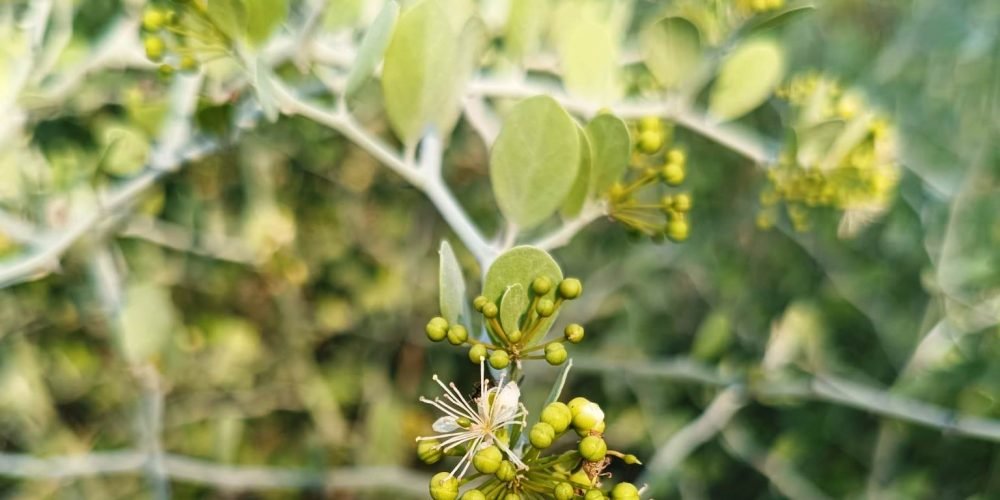
A thorny shrub photographed in the Sanjeevi Malai Eco Park area has been identified as Capparis sepiaria L., commonly known as the Wild Caper or Thorny Caper. Belonging to the Capparaceae family, the plant is well adapted to the dry and semi-arid conditions characteristic of the region.
Capparis sepiaria is a much-branched, woody shrub that often grows into a dense bush. Its branches bear sharp spines, giving the plant a naturally protective character. The leaves are simple, alternate, and generally oval to elliptic in shape.
The plant produces white flowers with numerous prominent stamens, which can attract insects. Its small, rounded to ovoid, berry-like fruits contain several seeds.
The species is commonly found in scrublands, open forests, wastelands and rocky habitats, particularly in dry regions. Its ability to withstand dry conditions and relatively poor soils makes it well suited to such landscapes.
The Thorny Caper also has ecological and practical value. Its thorny growth makes it suitable for live fencing, while its extensive growth can contribute to soil stabilisation in dryland areas. The shrub can also provide shelter and resources for insects and other wildlife, making it useful in biodiversity-oriented planting and native vegetation restoration.
With its low water requirements and natural adaptation to dry conditions, Capparis sepiaria can also be considered for xeric gardens and other dry landscapes. The species is generally propagated through seeds, although successful germination may depend on seed maturity and appropriate pretreatment.
The presence of such native, drought-tolerant shrubs highlights the ecological diversity of the Sanjeevi Malai landscape and the importance of conserving plants adapted to the region’s natural conditions.
