


Author: Mrs. Rajashree Pradeep
Category: Mental Health
Emotional eating also known as stress eating or comfort eating is defined as the propensity to eat in response to positive and negative emotions.
While the term commonly refers to eating as a means of coping with negative emotions, it sometimes includes eating for positive emotions such as over eating when celebrating an event or to enhance an already good mood.
Emotional eating includes eating in response to any emotion, whether that be positive or negative. Most of the time people refer to emotional eating as ‘ eating to cope with negative emotions’.
A TEST
Are you an emotional eater?
- Do you eat more when you are feeling stressed?
- Do eat when you are hungry or when you are full?
- Do you eat to feel better , to be calm and soothe yourself when you are sad , mad , anxious, etc?
- Do you reward yourself with food?
- Does food make you feel safe ?
- Do you feel like food is a friend?
- Do you feel powerless or out of control around food?
EMOTIONAL EATING CYCLE
Emotional hunger cannot be filled with food. Eating may feel good in the moment but the feelings that triggered eating are still there. You beat yourself for messing up and not having more willpower.
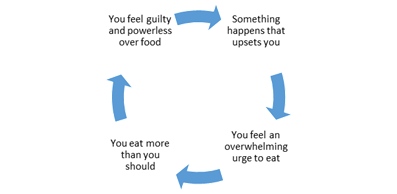
Compounding the problem, you stop learning healthier ways to deal with your emotions, you have a harder time controlling your weight. You can learn healthier ways to deal with your emotions, avoid triggers, conquer cravings, and finally put a stop to emotional eating.
Common causes of emotional eating are stress, stuffing emotions, boredom or feeling of emptiness, childhood habits and social influences.
Keeping an emotional dairy helps to recognise the patterns that you follow be it feeling of happiness and stress how you cope with the above in terms of regulation of your feelings. Learning to know the difference between emotional hunger and physical hunger is needed.