

Category: Carbon Neutrality
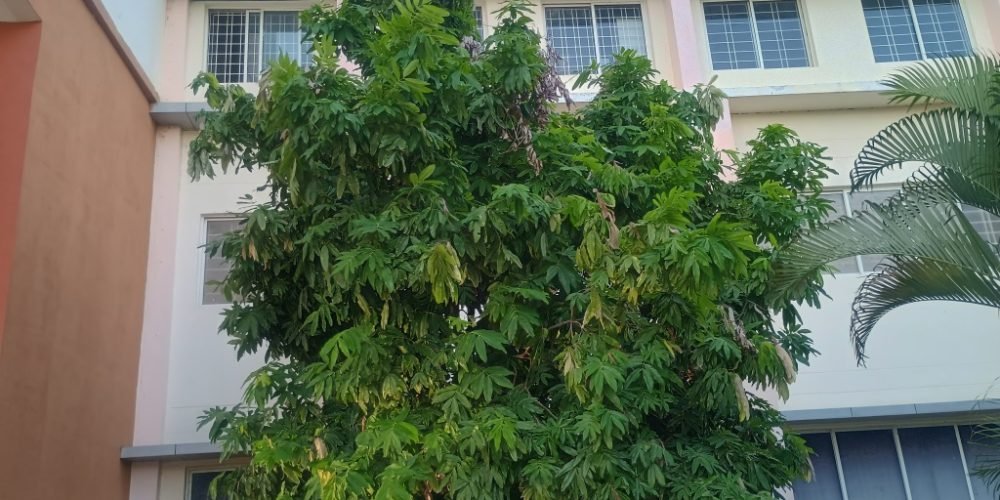
This photograph was taken at Ramco Institute of Technology (RIT) and features Saraca asoca, commonly known as the Ashoka tree, whose Sanskrit name means “without sorrow” (a = without, shoka = sorrow). It is a medium-sized evergreen tree belonging to the Caesalpinioideae subfamily of the Fabaceae family and is one of the most culturally significant tree species of the Indian subcontinent. The species is sometimes incorrectly referred to as Saraca indica.
True Saraca asoca trees are relatively uncommon in urban areas today. Within the city, only a few mature specimens are known, and two of them are located on the RIT campus, making them valuable additions to the institution’s green landscape and biodiversity.
Renowned for its dense foliage and striking clusters of fragrant flowers, the Ashoka tree is highly ornamental. Its blossoms emerge in shades of yellow and orange before gradually turning deep red, creating a spectacular display during the flowering season. The tree is often planted near temples, heritage sites, and gardens, where it is admired for both its beauty and symbolic value.
The Ashoka tree occupies a special place in Indian culture, literature, and Buddhist traditions. For centuries, it has been associated with love, fertility, prosperity, and the removal of grief, and is frequently mentioned in ancient Sanskrit texts and epics. Its name itself reflects the traditional belief that it helps dispel sorrow and bring emotional well-being.
Beyond its cultural importance, Saraca asoca is also valued in Ayurveda, where its bark and flowers have long been used in remedies related to women’s reproductive health, menstrual disorders, and inflammatory conditions. Despite its significance, the species is becoming increasingly uncommon due to habitat loss and urbanisation. It is also often mistaken for the commonly planted “False Ashoka” (Polyalthia longifolia), which is an entirely different species. The presence of genuine Ashoka trees at RIT therefore represents an important element of campus biodiversity.
