

Category: Carbon Neutrality
As cities across India grapple with rising temperatures and more frequent heatwaves, a quiet but significant climate adaptation initiative is taking shape in Rajapalayam. The Government of Tamil Nadu, through the Tamil Nadu Green Climate Company (TNGCC), has launched a pilot Cool Roof project in the city that seeks to reduce indoor temperatures in public buildings using a simple yet scientifically proven solution: high solar-reflective roof coatings.
The Rajapalayam pilot forms part of Tamil Nadu’s larger climate adaptation efforts. Earlier this year, the state introduced India’s first Standard Operating Procedure for Cool Roof Coating Application and expanded cool roof installations across hundreds of Green Schools. A previous pilot in Chennai demonstrated that cool roofs could reduce classroom temperatures by approximately 2-4°C, improving thermal comfort for students while lowering the need for mechanical cooling.
To evaluate the technology across different types of public infrastructure, the following five buildings representing diverse sectors have been selected in Rajapalayam:
- Government Girls Higher Secondary School, Chatrapatti
- ADKR Girls Higher Secondary School
- ADKR Middle School
- Rajapalayam Government Maternity Hospital
- Rajapalayam Municipality Office
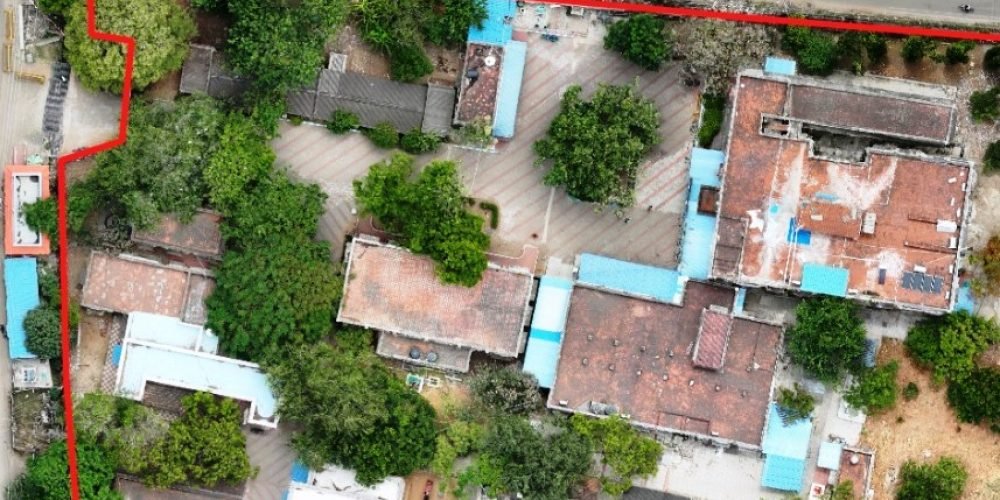
(The picture above shows the drone view of the roof of the Government Maternity Hospital.)
The selected buildings represent the education, healthcare and government administration sectors, allowing the project team to assess how the cool roof technology performs under varying building designs and occupancy patterns.
The concept behind the technique is straightforward. Instead of allowing rooftops to absorb the sun’s heat, a specially formulated reflective coating is applied to the roof surface. The coating reflects a large portion of the incoming solar radiation back into the atmosphere while emitting absorbed heat more efficiently, thereby reducing the amount of heat transferred into the building below. This passive cooling technology can help lower indoor temperatures, improve thermal comfort, and reduce dependence on fans and air-conditioners.
Before the coating is applied, engineers inspect each rooftop for cracks and structural defects. Any cracks identified are repaired to ensure the coating adheres properly and delivers long-lasting performance. Once the roof is prepared, the reflective paint is applied following standard operating procedures developed for cool roof implementation.
Engineers from Ramco Community Services are providing technical support for the initiative. Their work includes taking detailed measurements of the buildings, preparing engineering drawings, documenting roof conditions, and carrying out baseline and post-installation temperature studies to scientifically evaluate the effectiveness of the intervention.
